Teams usually ask this after a model gives wrong or generic answers. RAG and fine-tuning fix different problems, and picking the wrong one means building something that does not fix yours.
What each one changes
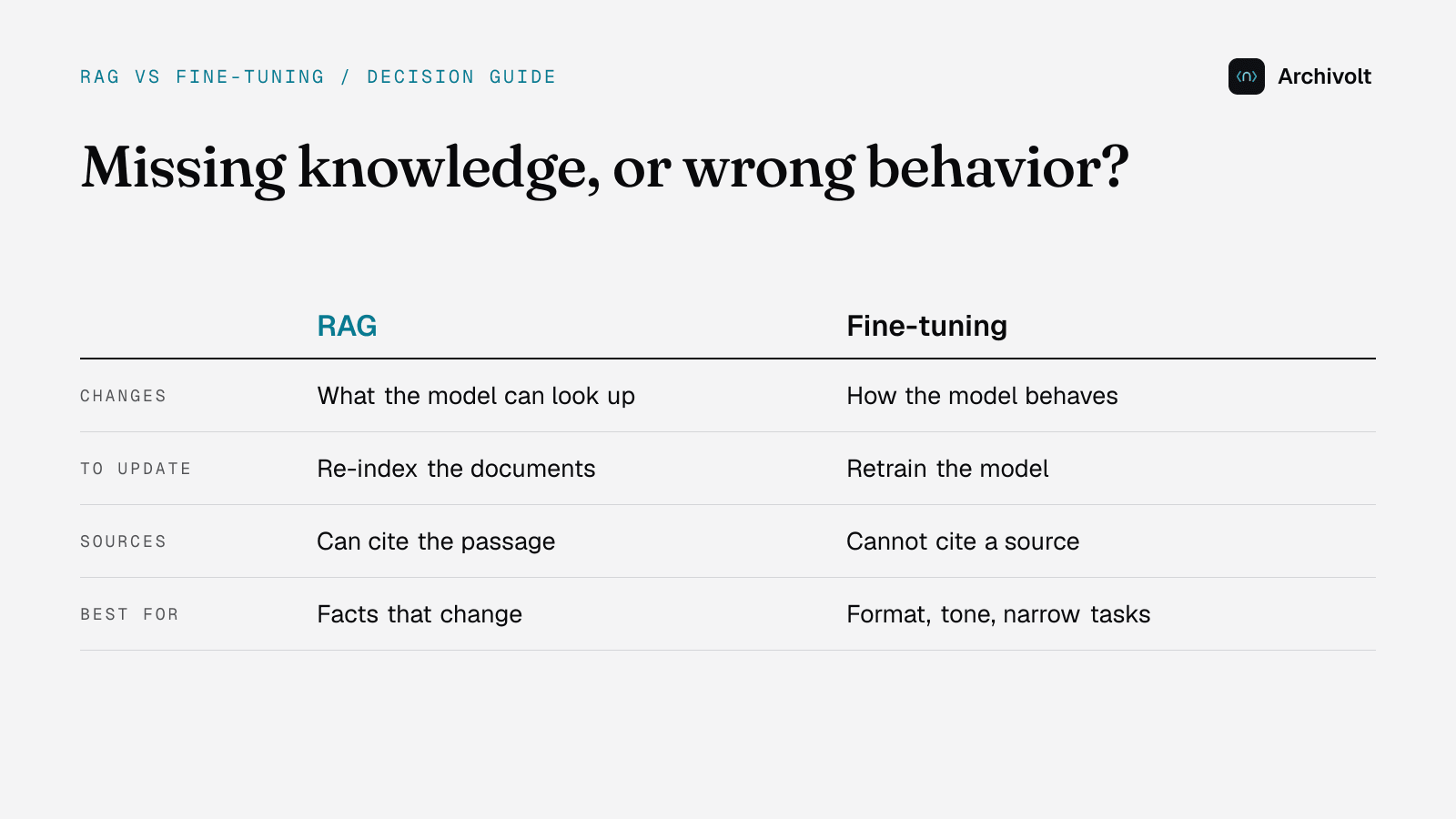
RAG leaves the model unchanged and controls what it sees at question time. The system retrieves relevant passages from your documents and adds them to the prompt. The full pipeline is covered in What is RAG?.
Fine-tuning changes the model. You train it further on examples of the input and output you want, so it picks up a format, a tone, or a narrow task. What it learns ends up in the model's weights.
Use RAG when the problem is missing knowledge
- The answer lives in documents that change, such as policies, pricing, or product docs. You update the document and re-index it. A fine-tuned model has to be retrained.
- Users need to see sources. Retrieved passages can be cited. Facts absorbed during fine-tuning cannot be traced back to a document.
- Different users may see different data. Retrieval can filter by user or tenant. Data baked into model weights is available to everyone who can query that model.
Use fine-tuning when the problem is behavior
- You need a fixed output format that prompting does not hold reliably, such as strict JSON for a downstream system.
- You have a narrow, repeated task and many labeled examples, such as sorting support tickets into your own categories.
- You want a smaller, cheaper model to do one job that a larger model does with a long prompt. Test this on your own task before committing to it.
Two mistakes we see
- Fine-tuning to teach facts. The model memorizes some of them unreliably, the facts go stale the day a document changes, and you cannot cite a source. If the model does not know your content, retrieval is the fix.
- Using RAG to fix tone or format. Retrieved passages do not make a model write in your style or return clean JSON. That needs prompt work first, then fine-tuning if the prompt cannot hold it.
Using both
The two can work together. A common setup fine-tunes a model to follow your output format and uses RAG to supply the facts. Most teams should start with a clear prompt and RAG, and add fine-tuning only when testing shows a behavior gap that prompting cannot close.
How to decide with your own data
- Write down real questions your users ask, with the correct answer for each.
- Run them against the model with a clear prompt and a few examples. Note how each wrong answer fails.
- If answers are wrong because the model lacks the information, add retrieval.
- If answers have the right content in the wrong shape, fix the prompt, then consider fine-tuning.
- Keep the question set and re-run it after every change, so you can see whether the change helped.
That question set doubles as the test suite once the system ships. If the retrieval side is where you are stuck, why RAG demos break in production walks through the failure points in order.
Related case study
Ragix — Production RAG Platform →A production RAG system that cites its sources, refuses when it doesn't know, and enforces tenant boundaries at the database level — not in the prompt.
Need this built right the first time?
Archivolt is a software studio that partners with founders and growing businesses to plan, build and launch custom software, SaaS and AI products. We stay with you from the first idea through launch and beyond, so you can focus on growing your business.
Schedule a call