"How long will this take?" is the first question almost every founder asks, and it's usually answered with a number that means nothing — "a few months," pulled out before anyone has actually looked at what's being built. The honest answer is a range, and the range is wide: a well-scoped MVP with a clear feature set typically ships in six to ten weeks. A vague one with an undefined scope can run twice that, not because the work is harder, but because nobody agreed on what "done" means before the clock started.
The timeline isn't really a build problem. It's a scoping problem wearing a build problem's clothes.
What actually determines the timeline
Two MVPs with a similar feature count can take wildly different amounts of time, and the difference almost never comes down to how fast the engineers type. It comes down to a handful of specific factors:
- Scope clarity. A documented feature list with explicit edge cases and explicit exclusions moves fast. A one-paragraph product vision gets rebuilt twice because "obviously it should also do X" surfaces in week five.
- Third-party integrations. Payments, auth providers, external APIs, and anything with its own approval process (app store review, a partner's sandbox access) introduce waiting time that has nothing to do with how much code gets written.
- Compliance and data sensitivity. HIPAA, SOC 2, or anything touching regulated data adds real review and documentation time that a consumer social app simply doesn't carry.
- Decision latency. A single product owner who can approve a design in a day moves faster than a committee that meets weekly. This is the factor founders underestimate most, because it's about their own organization, not the vendor's.
The four-phase breakdown
We run every engagement through the same four stages — described in full on how engagements work — and each one has a real job in the timeline, not just a name on a slide.
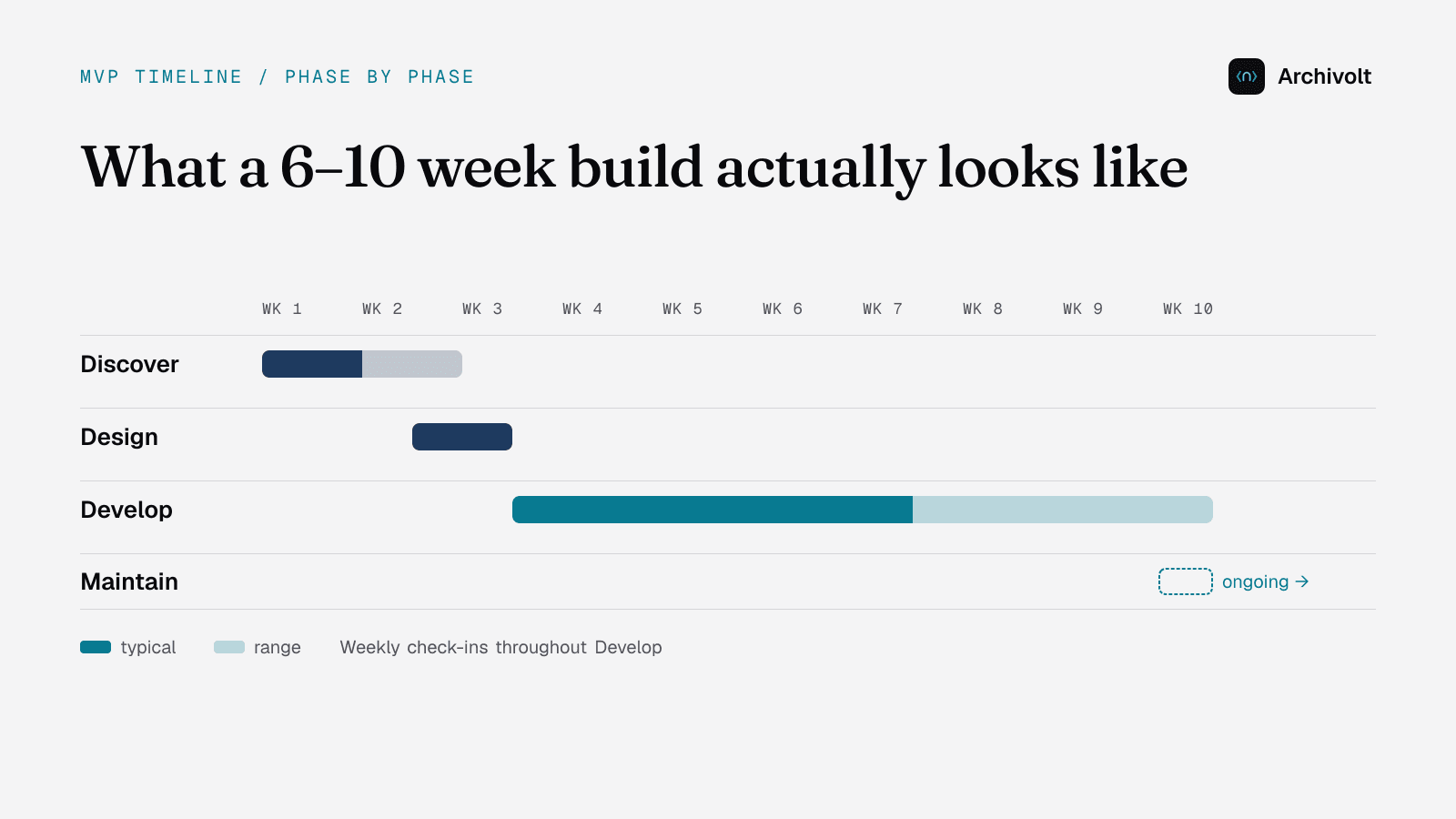
- Discover (roughly 1–2 weeks). Mapping goals, constraints, and users so the team builds the right thing from day one. This is where "obviously it should also do X" gets surfaced and decided on paper, before it's a surprise mid-build.
- Design (roughly 1 week, often overlapping with the end of Discover). Architecture, data models, and user flows documented before a line of production code is written. Skipping this is the single most common reason a 6-week estimate turns into 14.
- Develop (the bulk of the timeline — typically 4–7 weeks for a focused MVP). Iterative builds with weekly check-ins, so you see working software throughout instead of a reveal at the end.
- Maintain (ongoing, starting at handover). Full handover — code, deploy, and docs — then ongoing support as the product grows. This phase has no fixed end date by design.
Why "just add one more feature" costs more than it looks like
A feature request mid-build rarely arrives as “add this isolated thing.” It usually touches the data model underneath three other screens, needs its own edge-case decisions, and competes for the same reviewer's attention as everything already in flight. A change that looks like a day of work often costs three: a day to build it, a day to rework what it touches, and a day of schedule slip because the reviewer's calendar didn't have a free afternoon this week either. None of that shows up when the request itself is framed as small.
The feature isn't expensive. The decision to add it without re-scoping everything it touches is.
Signs an estimate is fiction
- A fixed launch date was set before requirements were documented — the date came first, the scope got bent to fit it.
- The estimate has no discovery phase in it at all. Someone quoted a timeline from a feature list alone, which means every edge case gets discovered, and re-estimated, during the build.
- "It'll take about two weeks" was said in the first conversation, before anyone had seen the existing codebase, data, or integrations it has to work with.
- The plan has no checkpoints before the final delivery date — a single estimate for the whole project with nothing to verify progress against until it's due.
What this looks like at Archivolt
We scope and price before a line of code is written, fixed price for well-defined work or milestone-based for larger builds — the reasoning is on our pricing page. The goal of the discovery and design phases isn't bureaucracy; it's removing the guesswork that turns a 6-week estimate into a 14-week one.
Our Secure E-Commerce Ordering POC shipped fixed-price, full-stack — frontend, backend, and database — on time, with the client noting it exceeded the original scope rather than missing the original deadline. That's the outcome a real discovery phase is built to produce: not a heroic sprint at the end, just an estimate that was accurate because it was based on the actual scope instead of a guess.
If your current timeline was quoted before anyone wrote down what you're actually building, that's worth fixing before week one starts, not week six.
Related case study
Secure E-Commerce Ordering POC — ASP.NET Core →Delivered fixed-price, full-stack (frontend, backend, and database), rated 5.0 by the client, who noted it was delivered on time, exceeded the original scope, and was "professional, responsive, and easy to work with."
Need this built right the first time?
Archivolt is a software studio that partners with founders and growing businesses to plan, build and launch custom software, SaaS and AI products. We stay with you from the first idea through launch and beyond, so you can focus on growing your business.
Schedule a call