Most founders ask the wrong question. "Agency vs freelancer vs in-house" is framed as a permanent preference, as if one model is objectively better and you just need someone to confirm which one. The real question is narrower: which model fits where your product is right now, given your budget, your timeline, and how much ongoing ownership you want to carry.
All three models have legitimate uses. All three can fail spectacularly in the wrong context. The goal of this post is to give you a framework for the decision — not a ranking.
The freelancer model — what it's actually good for
A freelancer is one person, working independently, usually on an hourly or project rate. The advantages are real: you're hiring a specific skill set directly, the cost is lower than an agency for the same number of hours, and the relationship is simple — no account managers, no overhead.
The tradeoffs are also real. A single person has a ceiling on how much they can hold: a senior backend engineer can build an API, but they probably can't also own your infrastructure, your CI pipeline, and your frontend in parallel. You get a skill, not a team. And when that person is sick, on holiday, or simply moves on, you own the continuity problem entirely.
A freelancer works well for a bounded, well-defined piece of work — a specific integration, a UI component, a data migration. It works poorly when you need someone to own a product end-to-end, or when the scope is genuinely uncertain.
The quality range is also extremely wide. The same platform that lists a $20/hr developer who will deliver something technically functional but unmaintainable also lists a $150/hr specialist with a decade of domain expertise. Knowing which you're hiring requires vetting that takes real time, and the cost of a wrong hire on a 3-month project is not just the invoice — it's the rebuild.
Building in-house — the real cost calculation
The appeal of in-house is ownership and alignment: someone whose entire job is your product, who accumulates context over time, who cares about the outcome the way a contractor often doesn't. These are genuine advantages, and for a product that's found market fit and needs continuous iteration, a strong in-house team is usually the right long-term answer.
The part that's frequently underestimated is the actual cost and lead time. A senior engineer in a major city costs between $130k–$200k in salary alone before employer taxes, benefits, equity, tooling, and management overhead. Recruiting takes months. Onboarding takes more months. And if the hire doesn't work out, the cost of parting ways and restarting the search is substantial.
- Salary + benefits typically runs 1.3–1.5× the base salary figure in total cost
- Time-to-productivity for a new senior hire is usually 60–90 days in an established codebase
- A single missed hire can cost 6+ months of runway in a pre-Series A company
- Two engineers are not twice the output of one — coordination, reviews, and alignment take real time
None of this means you shouldn't build in-house — it means the decision should be made clearly, not by default. If you're pre-product-market-fit and your needs are likely to shift significantly in the next 6 months, you're committing a fixed high-cost resource to an uncertain scope. That's a mismatch worth recognizing before you make the hire.
Working with a studio or agency
A software studio gives you a team — multiple disciplines, coverage across the stack, and a process designed for delivering end-to-end rather than a specific skill in isolation. The cost is higher per hour than a freelancer, but you're paying for depth of coverage and for the coordination overhead that would otherwise land on you.
The meaningful differences between studios are in how they structure engagements. An agency that quotes based on a vague brief and then reinterprets scope to manage margin is a well-documented failure mode. The thing to look for is whether the studio does a real discovery and scoping phase before committing to a number — not because they want to slow things down, but because an estimate that's built on an actual scope is the one that holds.
The question to ask any agency: what happens when the scope changes mid-project? Their answer will tell you more about the engagement than their initial pitch.
The other failure mode is handover. Some studios build things that only they can maintain — not intentionally, but because their process optimises for delivery speed rather than client ownership. Code quality, documentation, and a clean handover should be in scope from day one, not negotiated at the end.
Four questions that make the decision clear
In practice, the choice comes down to four questions:
- How well-defined is the scope? — A clearly bounded piece of work suits a freelancer. An end-to-end build with some uncertainty suits a studio. Ongoing iteration on a live product suits in-house.
- How much coordination do you have capacity for? — A freelancer puts the coordination burden on you. A studio handles it internally. In-house requires you to be a capable engineering manager, or hire one.
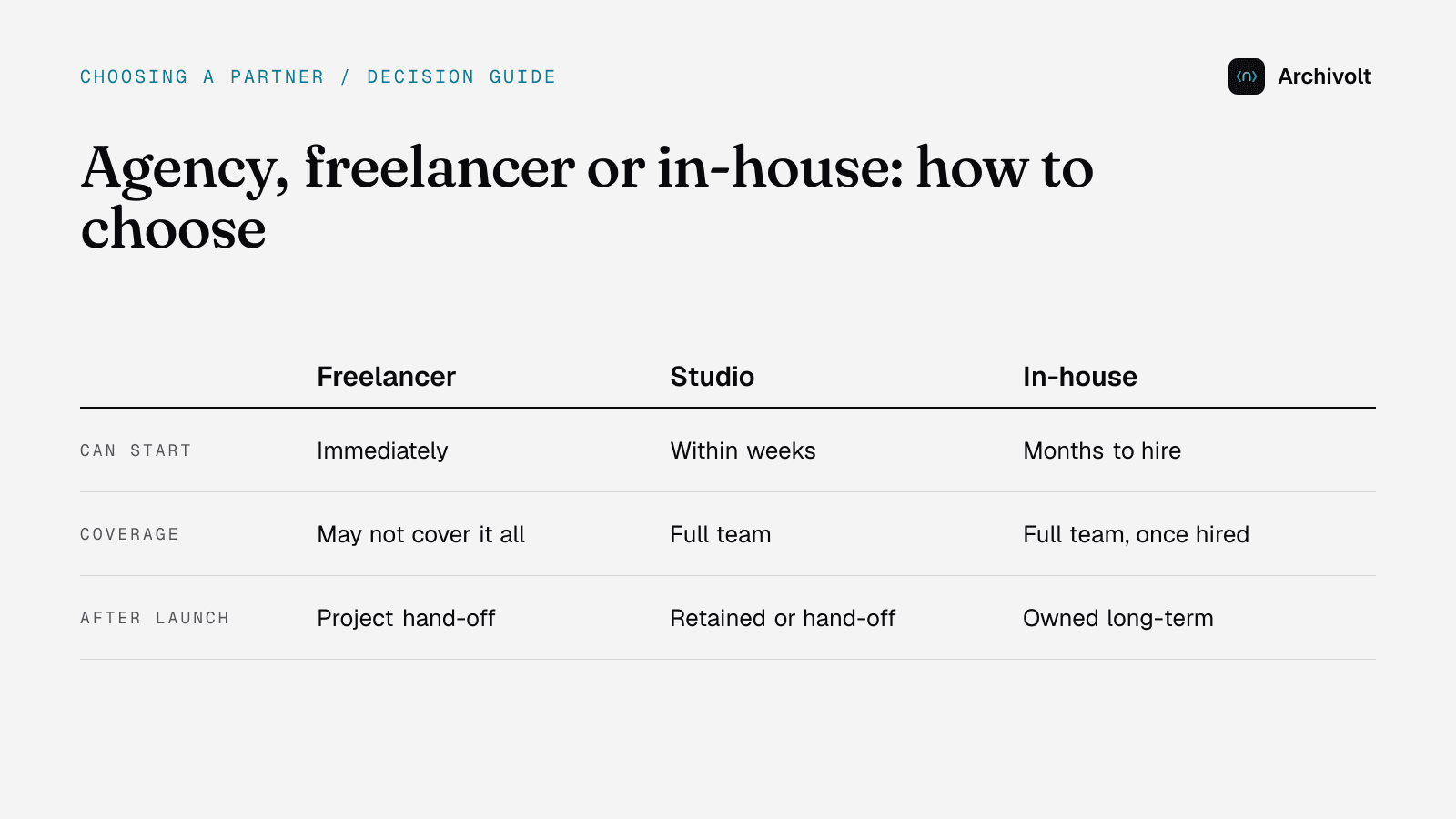
- What's your timeline? — Hiring in-house takes months. A studio can typically start within weeks. A freelancer can start immediately but may not have the coverage you need.
- What happens after launch? — If you want the team to own the product long-term, in-house or a retained studio relationship makes sense. If it's a one-time build you'll hand off to your own team, a project-based engagement is the right shape.
How Archivolt's engagement model works
We work with founders and growing businesses on custom software, SaaS platforms, and AI products — end-to-end, from discovery through launch and ongoing support. We're not a freelancer marketplace and we're not a large agency with account layers. We stay deliberately small so every project has senior engineers owning it, not managing it.
Every engagement starts with a discovery and scoping phase: documenting what you're building, what production-ready means for this specific product, and what the realistic timeline looks like before we commit to a number. Fixed price for well-defined work. Milestone-based for larger builds where scope genuinely evolves. No hourly billing that puts the delivery risk entirely on the client.
If you're evaluating whether a studio engagement is the right fit for where you are, the best first step is a 30-minute call — not to pitch, but to understand what you're building and whether we're actually the right shape for it.
Need this built right the first time?
Archivolt is a software studio that partners with founders and growing businesses to plan, build and launch custom software, SaaS and AI products. We stay with you from the first idea through launch and beyond, so you can focus on growing your business.
Schedule a call